
Retiring in the US from Australia: visitor stays, costs, pension and health cover (2026)
Hawaii is about 10 hours from Sydney, and there's a social security agreement. Visits are the realistic option unless you have family there or a US passport.

Checked 21 October 2026, re-checked monthlyBy the Retirees Abroad teamGeneral information only, how we check
The short answer
The US has no retirement visa. Australians can usually visit for up to 90 days on an ESTA, and federal rules admit a B-2 visitor for at least 6 months. Our estimate for a month in Honolulu is about A$11,510 for a couple or A$8,830 for one person, rent included (October 2026). Medicare does not cover you in the US.
United States at a glance
- A comfortable month, couple
- About A$11,510
- A comfortable month, one person
- About A$8,830
- Visa for a visit
- 90 days on an ESTA; no retirement visa
- Weather
- Honolulu warm all year; the mainland varies by state
- Costs based on
- Honolulu
- Medicare agreement
- No
- Social security agreement
- Yes
- Tax treaty with Australia
- Yes (1982, amended by a 2001 protocol)
- Long-stay visa
- None for retirees; a B-2 visitor is admitted for at least 6 months
- Flight from Sydney
- About 10 hours non-stop to Honolulu
- Time difference
- Honolulu is 20 hours behind Sydney, 21 in our daylight saving
Costs are mid-range estimates in Australian dollars, rent included, for a comfortable month. For comparison, a comfortable month in Australia is about A$6,580 for a couple who own their home (ASFA, June quarter 2026).
Who the US suits, and what to weigh up
The US suits a long visit more than a move. There is no retirement visa, so living there takes US citizenship or a green card. Australians can usually apply to visit for up to 90 days on an ESTA, or for longer on a visitor visa, though a past refusal or some travel histories rule out the ESTA. That makes the US a fit for a winter away, or time with grandchildren who live there.

Your family decides most of it. A child who is a US citizen aged 21 or over can sponsor you for a green card, and a US passport lets you live there now. Without either, the usual plan is visits from a home base in Australia. Investor routes and a visa lottery exist too, and the visas section sets them out.
Medical bills come first. Smartraveller says a doctor’s visit for a minor problem can cost thousands of dollars. US Medicare at 65 depends on US work history or long-term residence, so a visitor usually relies on travel insurance. Entry checks are strict, and an approved ESTA or visa doesn’t guarantee you’ll be let in.
A social security agreement means you can generally claim the Age Pension from the US. Hawaii is about 10 hours from Sydney. Honolulu, our cost base, is expensive; Phoenix comes in about a third lower.
What a month costs
Our estimate for a month in Honolulu is about A$11,510 for a couple and A$8,830 for one person, rent included.
| A month in Honolulu | Couple | One person |
|---|---|---|
| Rent, one-bedroom flat in the centre | A$4,210 | A$4,210 |
| Living costs (food, transport, bills) | A$4,640 | A$2,580 |
| Eating out, local trips and extras (30%) | A$2,660 | A$2,040 |
| Total | A$11,510 | A$8,830 |
How a month in the US compares
For a couple
- the US, our estimate
- A$11,510
- Comfortable in Australia
- A$6,580
- Age Pension, the most paid in Australia
- A$4,040
About A$4,930 a month more than a comfortable month in Australia.
For one person
- the US, our estimate
- A$8,830
- Comfortable in Australia
- A$4,680
- Age Pension, the most paid in Australia
- A$2,680
About A$4,150 a month more than a comfortable month in Australia.
Not built the same way: Australia's figure (ASFA Retirement Standard, comfortable, June quarter 2026) assumes you own your home and includes health insurance; our estimate for the US includes rent and leaves health insurance out. Age Pension: the most paid in Australia from 20 September 2026; living overseas for good, the base rate is about A$3,710 a month for a couple and A$2,460 for one person.

Our estimate: Numbeo’s living costs for one person (without rent) plus a one-bedroom city-centre rent, plus 30% for eating out, local trips and extras. For a couple, living costs times 1.8. Converted at the Reserve Bank of Australia’s average exchange rate for the 12 months to September 2026 (A$1 = US$0.6919). Health insurance is not included. We use Numbeo’s Honolulu page, last updated 20 October 2026: US$1,785 a month (about A$2,580) in living costs for one person and US$2,913 (about A$4,210) for a central one-bedroom flat.
On the same page Numbeo puts Honolulu’s living costs, before rent, about 36% above Melbourne’s, and its rents about 48% higher.
A mainland comparison: Phoenix. Mainland costs vary by state and city, so here is one desert city worked out the same way. Numbeo’s Phoenix page, last updated 21 October 2026, puts living costs for one person at US$1,263 a month (about A$1,830) and a central one-bedroom flat at US$1,795 (about A$2,590). For one person, A$1,830 plus A$2,590, plus 30%, makes about A$5,750. For a couple, A$1,830 times 1.8 is about A$3,290; add the rent and 30% and it makes about A$7,640. Numbeo’s comparison puts Melbourne’s living costs, before rent, about 5% above Phoenix’s, and Melbourne’s rents about 5% higher.
Against the Age Pension. After 12 weeks away, the most the pension pays is the base rate: about A$2,460 a month for one person and A$3,710 for a couple, before tax (rates from 20 September 2026). That leaves a couple about A$7,800 a month short of our Honolulu estimate. One person is about A$6,370 short. In Phoenix the gap is about A$3,930 for a couple and A$3,290 for one person.
What costs more than you’d expect. Health cover sits outside our estimate. The Centers for Medicare & Medicaid Services puts US health spending at US$15,474 per person in 2024 (about A$22,360). Most states and towns charge a sales tax, USAGov says. A car isn’t in our estimate either. Then there are flights home for birthdays and funerals, and BITRE’s June 2026 figures show flights to Australia from just five US cities.
Renting long term. Each state sets its own tenancy law, so this is Hawaii’s. Hawaii’s consumer protection office says a security deposit can be no more than one month’s rent, pet deposits included. What’s left comes back within 14 days of the tenancy ending, with a written list of deductions. On a month-to-month agreement, the landlord gives at least 45 days’ written notice to end it, and the tenant at least 28 days’. Our table uses long-term rent; a furnished let for a few months may cost more.
Visas for Australians

Australians can usually visit for up to 90 days on an ESTA, or apply for a visitor visa for a longer stay. The US has no visa for retirees. For a retiree, a green card usually comes through family, though there are investor routes and a visa lottery too.
Up to 90 days: the ESTA. Smartraveller says you apply online before you go, and approval can take up to 72 hours. US Customs and Border Protection (CBP) says an ESTA usually lasts 2 years, or until your passport expires, for stays of 90 days or less. The program is for short, infrequent visits. You can’t work, and Smartraveller says that includes volunteering, house sitting or pet sitting.
US immigration says you can’t extend a Visa Waiver stay, and a trip to Canada, Mexico or the Caribbean doesn’t reset the clock. If you stay longer than 30 days, Smartraveller says you must register with US authorities. US Citizenship and Immigration Services (USCIS) says visitors issued an I-94 arrival record are already registered.
Fake ESTA sites. CBP warns of websites and emails made to look like official US government sites, and says paying a third-party site won’t make approval faster. The official site ends in .gov.
Longer: a visitor visa. For more than 90 days you need a B-2 visitor visa, with an interview at a US embassy or consulate in Australia. Under the federal rules (8 CFR 214.2(b)), a B-2 visitor issued an I-94 is admitted for at least 6 months, apart from individual exceptions, and no B visitor for more than a year. The officer at the airport sets the date, and your I-94 record shows it. USCIS takes requests to extend on Form I-539, and suggests lodging at least 45 days before your stay ends.
At the border. Smartraveller says officers may ask about your plans and your ties to Australia, inspect your phone, and ask for a return ticket and proof you can support yourself.
A child who is a US citizen. USCIS counts the parent of a US citizen aged 21 or over as an “immediate relative”. Your child lodges a petition for you (Form I-130). USCIS says visas for immediate relatives are unlimited, so there’s no queue. From outside the US, the application goes through a US consulate.
A partner who isn’t a US citizen. The spouse of a US citizen is also an immediate relative, so an American partner can sponsor the other for a green card.
If you already hold a US passport. None of the visitor limits apply to you. US tax still does, so read the tax section too.
Investing: the EB-5 green card. USCIS’s EB-5 program lets investors, their spouses and unmarried children under 21 apply for green cards. The money goes into a new US business that will create full-time jobs for at least 10 workers. For petitions filed from 15 March 2022 the minimum is US$1,050,000 (about A$1.5 million), or US$800,000 (about A$1.2 million) in a targeted employment area. USCIS says inflation adjustments start with petitions filed from 1 January 2027.
Running a business: E-2 status. Australia has been an E-2 treaty investor country, on the State Department’s list, since 27 December 1991. E-2 is temporary, not a green card. USCIS says the investor puts a substantial amount at risk in a real, operating US business and comes to develop and direct it. Stays run up to 2 years at a time, renewable without limit, but you must intend to leave when the status ends.
The diversity visa lottery. USCIS says this program gives out immigrant visas each year, drawn at random from people from countries with low rates of immigration to the US. The State Department’s DV-2026 instructions listed Australia as eligible. Each entrant needed a high school education, or two years’ work in the past five years in a job that needs two years’ training or experience. USCIS warns of emails falsely claiming you’ve won.
Keeping a green card. USCIS says an absence of more than a year can be taken as giving up a green card, and a shorter one can be too, depending on your intentions. Before a long absence you can apply for a re-entry permit, valid for up to 2 years. An absence of 6 months or more can also affect a later citizenship application.
Documents to get in Australia before you go. Australian birth, marriage or police certificates are easier to get while you’re in Australia. The AFP’s national police check costs A$57, and the AFP says most online checks arrive within a few days. A check with fingerprints costs A$114 and takes 15 to 30 business days.
Visa rules change. The US embassy, USCIS or a licensed US immigration lawyer can tell you what applies to you, how long it takes from Australia, and what you can do while you wait. Our guide to retirement visas by age covers countries that do have a retiree visa.
Your Age Pension and Medicare in the US
Services Australia says your Age Pension can keep paying overseas. After 6 weeks the Energy Supplement stops and your Pensioner Concession Card is cancelled. The Pension Supplement stops at 12 weeks (since 20 September 2026). After 26 weeks your rate can be reduced if you lived in Australia less than 35 years between age 16 and pension age. See the 6, 12 and 26-week rules.
The US is one of Australia’s social security agreement countries, and that changes how you claim. Without an agreement, you have to live in Australia on the day you claim. Services Australia’s factsheet says the agreement generally lets you lodge an Age Pension claim from the US, through the US social security agency, and lets US social security cover count towards Australia’s 10 years’ residence. Our guide to claiming before you leave sets out the usual route.
If you worked in the US, a US Social Security pension is a separate claim, decided by the US. If you move for good, you get the base rate only from the day you leave: A$29,520.40 a year single, A$44,506.80 for a couple. Our guide to moving overseas for good explains what changes.
Medicare never pays for treatment overseas, and the US is not one of Australia’s 11 reciprocal health care countries. An Australian citizen who moves overseas can still use Medicare on visits home for up to 5 years, and visits don’t restart that clock. For permanent residents, enrolment ends 12 months after they leave. See Medicare overseas.
Health care and insurance

Smartraveller says hospitals are of a similar standard to Australia’s, but the bills are much bigger, and you may need proof of insurance or payment before treatment. It says travel insurance should cover the whole stay, conditions you already have and all medical costs, including evacuation.
US Medicare and visitors. The Centers for Medicare & Medicaid Services says Medicare is for people aged 65 or over, and some younger people with a disability or kidney failure. Premium-free hospital cover (Part A) comes from a US work record, yours or a family member’s, and being eligible for US Social Security or railroad retirement benefits. Without that, you pay a premium, and you must live in the US and be a US citizen or a permanent resident of 5 years in a row. A visitor on an ESTA or a B-2 visa doesn’t meet that test. A parent who gets a green card through a child waits those 5 years too, unless they qualify through a work record.
What is where. Hawaii’s health department lists one Level I trauma centre, for the most serious injuries, in Honolulu on Oahu, plus several Level III centres. Maui, Kauai and the Big Island have Level III centres only, so serious cases can mean a flight to Oahu. On the mainland, Arizona’s health department lists Level I trauma centres in both Phoenix and Tucson. California’s emergency medical services authority lists several in Los Angeles County and one in San Francisco.
Cover gets harder to find with age, and trip limits differ; see travel insurance for long stays. Questions to ask: whether the US is included and at what price, how long a single trip can run at your age, and whether it covers getting you home. If you’d like help working out where to start, book a free planning session on Zoom.
Smartraveller says some medicines sold in Australia are illegal or controlled in the US, even with an Australian prescription, and it’s illegal to carry prescription medicine without a prescription. Our guide to taking medicines overseas has the Australian side.
Where Australians live
There’s no official count of where Australians stay in the US. These are the places to compare first.
| Area | What it’s like | Getting around | Hospital | Airport |
|---|---|---|---|---|
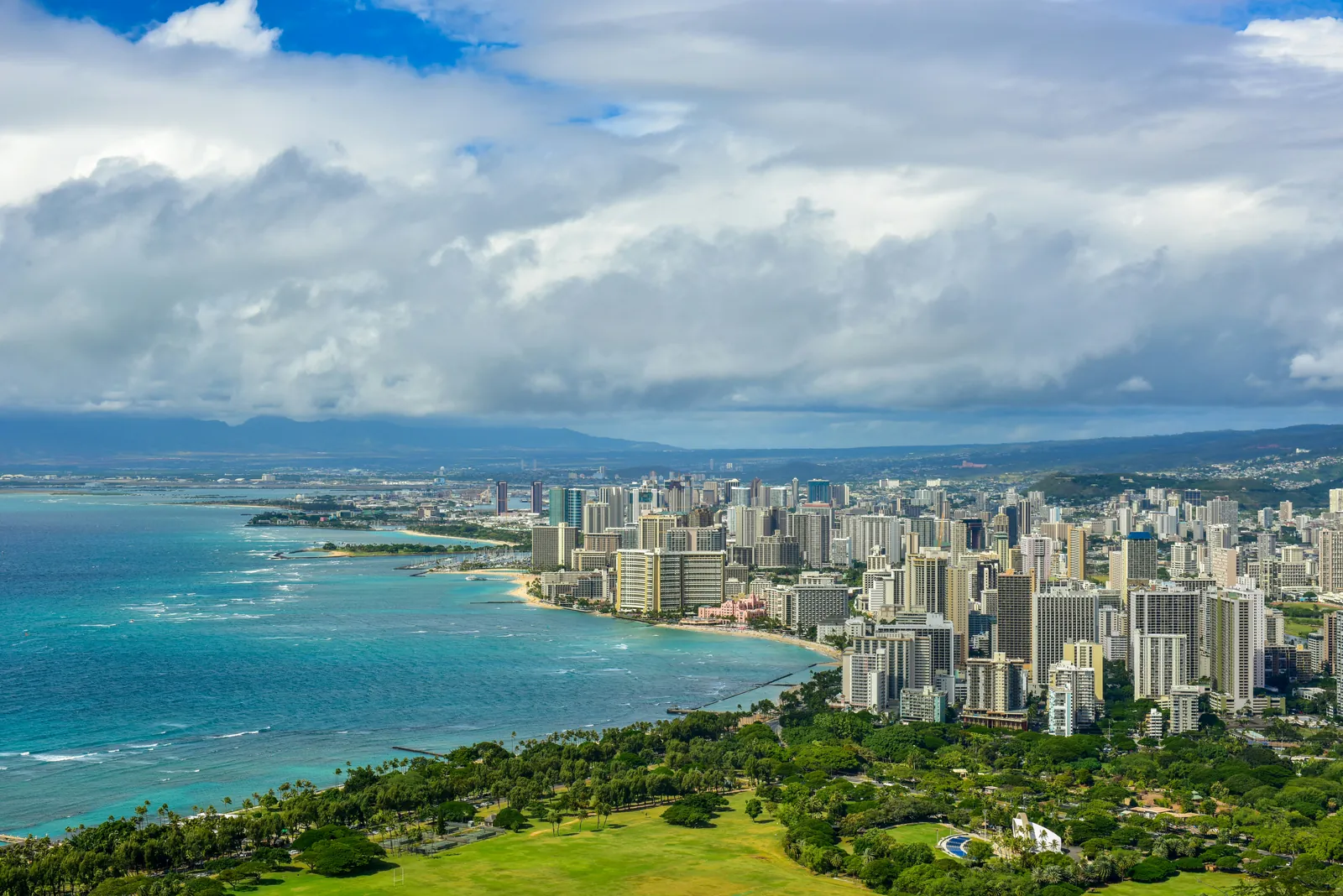
| Honolulu, Oahu | Hawaii’s capital; our cost base | City buses, with senior fares from 65 | Hawaii’s one Level I trauma centre | Non-stop flights from Sydney |
| Maui, Kauai and the Big Island | Smaller island towns | Spread out; a car helps | Level III trauma centres | No flight from Australia in BITRE’s June 2026 figures |
| Los Angeles and San Francisco | Big West Coast cities | Large cities; public transport varies by area | Level I trauma centres in both | Flights from Sydney, Melbourne and Brisbane |
| Phoenix and Tucson, Arizona | Desert cities; our mainland comparison | Spread out; a car helps | Level I trauma centres in both | No flight from Australia in BITRE’s June 2026 figures |
Honolulu is the closest part of the US, and our cost base.
Maui, Kauai and the Big Island are quieter, and serious care can mean getting to Oahu.
Los Angeles and San Francisco have flights from Sydney, Melbourne and Brisbane.
Phoenix and Tucson are our mainland comparison: on Numbeo’s figures, a month in Phoenix costs about a third less than in Honolulu.
Wherever your family lives often matters more. If grandchildren are the reason you’re going, their city sets your costs and flights. If you are weighing other places in the Americas, see our Mexico page.
Renting or buying a home
Foreigners can buy property in the US, and the IRS’s FIRPTA rules, below, cover foreign owners who sell. Buying a home doesn’t give you a right to live there: none of the USCIS pages we read lists it as a route to a green card.
Leasehold in Hawaii. Some Hawaii condominiums are leasehold. Hawaii’s real estate regulator says the buyer can use the apartment for the lease’s term but doesn’t own the land. Lease rent is usually fixed for set periods, then renegotiated, and it may rise a lot. At the end of the lease, owners may have to hand back the apartment and the land with no compensation.
When a foreign owner sells. Under the IRS’s FIRPTA rules, the buyer usually withholds 15% of the amount realised on the sale when the seller is a foreign person. There is no withholding when the buyer is buying a home to live in for US$300,000 or less (about A$434,000). A lower rate can apply up to US$1 million (about A$1.4 million).
People to ask. A real estate lawyer licensed in that state, and a US tax adviser, can explain the title, the lease and the tax before you sign. Our guide to overseas property and visa scams covers the warning signs. For the Australian side, see whether to keep, rent or sell the family home.
Tax: there and at home
The IRS treats you as a US tax resident if you hold a green card or pass the substantial presence test. That test counts days: at least 31 in the US this year, and 183 over three years. The total adds all of this year’s days, a third of last year’s and a sixth of the year before’s.
The IRS’s own example, 120 days in each of three years, comes to 180 days, just under the line. An exception can apply if you have a closer connection to another country.
What a US resident pays tax on. The IRS says US residents are taxed on their worldwide income, like citizens. US citizens living abroad report worldwide income too, so a dual citizen in Australia still files in the US.
State taxes. Each state sets its own taxes on top of federal ones. USAGov says state and local income tax depends on your income and where you live, and property taxes depend on value and location.
The tax treaty. Australia and the US have an income tax treaty, concluded in 1982 and amended by a 2001 protocol, the US Treasury says. How it treats your Age Pension, super or rent from a house in Australia depends on your details.
At home, the ATO’s residency tests decide whether you are still an Australian resident for tax; our guide to tax residency when you retire overseas walks through them. If you become a foreign resident, you lose the tax-free threshold, so Australian income such as rent is taxed at 30% from the first dollar (2025-26), as the foreign resident tax rates show. Sell your Australian home while you are a foreign resident and, for sales after 30 June 2020, you generally lose the main residence exemption from capital gains tax, apart from narrow life events.
Talk to a registered tax agent in Australia, and to a US tax adviser, before a long stay or a move.
Money and banking
Your pension is in Australian dollars and your bills are in US dollars.
Your pension. Services Australia sets how often and into which account it pays while you’re away, depending on how long you’ll be gone. Our guide to living overseas on the Age Pension has the numbers.
A local account. Each US bank sets its own rules on identity documents and a US address.
Moving money. The main options are a transfer from your Australian bank, a currency transfer service, or cash from an ATM on an Australian card. Each charges a fee and builds a margin into its exchange rate; ask for both. CBP says you must report currency of more than US$10,000 (about A$14,450) when you enter or leave the US.
Currency swings. At the RBA’s 12-month average rate, US$1,000 is about A$1,450; if the Australian dollar fell 10%, it would cost about A$1,610.
Day to day
Language. English, so daily life needs no new language.
Getting around without driving. Honolulu’s buses offer a senior fare card from age 65, and the operator says visitors 65 and over can get one with a passport as proof of age. A senior single fare is US$1.25 (about A$2), with transfers for two and a half hours, and fares stop at US$3 a day (about A$4).
Driving. Each state sets its own licence rules. Smartraveller says some states let you drive on an Australian licence for a limited time, and others also require an International Driving Permit, which you get in Australia before you leave. Driving without one where it’s required can void your travel and vehicle insurance. The City and County of Honolulu says Hawaii swaps licences without tests only for drivers from Japan, Korea and Taiwan.
Weather in Honolulu. Warm all year. NOAA data in the State of Hawaii Data Book (1991 to 2020) give daily highs averaging about 29°C and lows about 22°C, with January the coolest month and August the warmest. Rain is about 420 mm a year. NOAA says the central Pacific hurricane season runs from 1 June to 30 November.
Public holidays. The US has 11 federal holidays. In 2026 they include Memorial Day (25 May), Independence Day (observed on 3 July), Labor Day (7 September), Thanksgiving (26 November), New Year’s Day and Christmas Day.
Safety. Smartraveller says violent crime, gun crime included, is more common in the US than in Australia, and rates are highest in cities. Federal and state drug laws differ, on marijuana too, and penalties can be severe. Joining a protest, even online, can be treated as a breach of your status and grounds for deportation. Wildfires, hurricanes, tornadoes and winter storms regularly hit the US, and hurricane activity peaks from May to November. Read the current advice before each trip.
Help at home. Paid help is arranged privately, and we found no official figure for its cost.
Making friends. Family is the obvious start if you are going to them. In Honolulu, the senior bus fare makes it cheap to get to clubs and the beach.
Getting there and coming home
Non-stop flights from Sydney to Honolulu take about 10 hours: Flightmapper’s 2026 schedules show 9 hours 40 minutes to 10 hours 10 minutes. BITRE’s June 2026 figures show passenger flights from Sydney to Honolulu, Los Angeles, San Francisco, Dallas and New York. BITRE counts a city pair when one flight number links them, so a flight can stop on the way. From Melbourne, flights go to Los Angeles, San Francisco and Dallas, and from Brisbane to Los Angeles and San Francisco. Smartraveller says even passing through Hawaii means meeting US entry or transit rules.

Honolulu is 20 hours behind Sydney in our winter and 21 hours behind in our daylight saving, as Hawaii doesn’t change its clocks: 2pm Tuesday there is 10am or 11am Wednesday in Sydney. Los Angeles is 17 to 19 hours behind Sydney.
From Phoenix, Tucson or Hawaii’s other islands, BITRE’s June 2026 figures show no flight to Australia, so the trip home starts with a connection. On a green card, the absence rules above apply to a long stay back in Australia. If you come back to Australia to live, our guide to coming home covers your pension and Medicare.
Your first steps
One order that works, from a first visit to longer stays. Yours depends on your family, your health and your passport.
- Ask for help first. Book a free planning session on Zoom, or contact our team. Once we understand your situation, we can point you in the right direction.
- Visit first, on an ESTA, for a few weeks in the place you have in mind. Our guide to trying before you move has ways to test it.
- Talk it over with your partner and family early, especially a child in the US. Our guide to talking to your family has ways to start.
- Work out which route fits: ESTA visits, a B-2 visitor visa, or a green card through a US citizen child aged 21 or over or a US citizen spouse.
- Apply for the ESTA on the official .gov site, or for a B-2 visa, with its interview in Australia, for stays over 90 days.
- Check what happens to your Age Pension at 6, 12 and 26 weeks, and how the social security agreement lets you claim from the US.
- Find out what travel insurance covers at your age for the whole stay, including conditions you already have. See travel insurance for long stays.
- Check whether your medicines are legal in the US. See taking medicines overseas.
- Work out what happens to the house, and whether it counts for the pension while you are away.
- Keep a count of your days in the US, as the IRS’s substantial presence test can make a long-staying visitor a US resident for tax. See tax residency when you retire overseas.
- If a green card is the plan, gather Australian certificates while you’re home, and leave 15 to 30 business days for an AFP check with fingerprints.
- Know your way back: read the rules for coming home before you go.
Questions people ask
Can I retire in USA from Australia?
Not on a retirement visa: the US doesn’t have one. You can usually visit for up to 90 days on an ESTA, or longer on a visitor visa. Living there takes a green card or US citizenship. For a retiree the usual routes are family ones; the EB-5 investor green card and the diversity visa lottery exist too, and Australia is an E-2 treaty investor country.
How many months a year can I spend in the US?
The rules we read give no single yearly figure. Each ESTA visit is up to 90 days, and Smartraveller says the program is for short, infrequent visits. A B-2 visitor is admitted for at least 6 months a visit, and officers decide each entry. The IRS’s substantial presence test counts your days too, and 183 weighted days over three years can make you a US resident for tax.
How long can an Australian stay in the US without a visa?
Up to 90 days at a time on an ESTA. The stay can’t be extended, and a side trip to Canada, Mexico or the Caribbean doesn’t restart it.
How long can an Australian stay in the US on a tourist visa?
On a B-2 visitor visa, the federal rules admit you for at least 6 months, and never more than a year; the officer at the airport sets the date. You can ask USCIS for an extension on Form I-539, ideally 45 days before your stay ends.
Can an Australian citizen live permanently in the US?
Yes, with a green card or US citizenship. For a retiree the usual route is family: a US citizen child aged 21 or over, or a US citizen spouse, can sponsor you. The visas section covers the investor and lottery routes. A green card can be lost if you’re away for long periods.
Does Medicare cover me in the US?
No. The US has no reciprocal health care agreement with Australia, and Smartraveller says medical costs there are extremely high. At 65, US Medicare is premium-free only with a US work record; otherwise you pay a premium and must live in the US as a citizen or a permanent resident of 5 years.
Can I get the Age Pension while living in the US?
Yes. It keeps paying, with the usual 6, 12 and 26-week rules. Because the US is an agreement country, you can generally lodge a claim from there.
Can my child in the US sponsor me?
If your child is a US citizen aged 21 or over, USCIS counts you as an immediate relative, which is a route to a green card. Visas for immediate relatives aren’t limited in number. A US immigration lawyer or USCIS can tell you what the application involves.
Is the US a good fit?
Good for
- A winter away of up to 90 days, or longer on a visitor visa
- Visiting children and grandchildren who live in the US
Think about
- No retirement visa: living there takes US citizenship or a green card
- Medical costs Smartraveller calls extremely high, and US Medicare depends on US work history or long-term residence
- Strict entry checks, even with an ESTA
- Rent alone in central Honolulu is about A$4,210 a month
Places to compare
- MexicoVisitors can be given up to 180 days, and day-to-day costs are lower than at home. Lake Chapala, near Guadalajara, has an established foreign retiree community.
- PanamaA residence permit for people on a lifetime pension, US dollar notes, and private hospitals in Panama City. It is a long way from Australia.
- Costa RicaA mild climate in the Central Valley around San José, and a residence route that asks for a lifetime pension. Whether Australian pensions count is unconfirmed.
- FijiAbout 4 hours from Sydney, with a residence permit for people on their own income that starts at age 45.
- JapanNinety days without a visa, medical care of a high standard and non-stop flights of about 10 hours. Japan also has a social security agreement and a tax treaty with Australia.



Guides for this place
- Travel insurance for long staysTravel insurance over 70 and over 75 for a long stay: age limits by policy type, caps on trip length, pre-existing conditions and what to ask. Checked 2026.
- Medicare overseasDoes Medicare cover me overseas? No. The 11 reciprocal agreement countries, none in Asia, and the 5-year rule for Medicare on visits home. Checked 2026.
- Medicines overseasTaking PBS medicines overseas: how to do it legally, how much to take, why nobody can post them to you, and the fine of up to $16,500. Checked October 2026.
- The 6, 12 and 26-week rulesWhat happens to your Age Pension at 6, 12 and 26 weeks overseas, updated for the Pension Supplement change of 20 September 2026. Checked October 2026.
- Try before you moveTry retiring overseas before you move: the winter away, the long stay and the trial year, and what changes with your Age Pension, house and visa at each.
- Tax residencyIf you retire overseas, do you still pay tax in Australia? The ATO's four tax residency tests, what it weighs, and what changes for a foreign resident.




Sources
- Smartraveller: United States of America, checked 21 October 2026 (page updated 26 September 2026)
- US Customs and Border Protection: ESTA, checked 21 October 2026 (page dated 10 July 2025)
- US Customs and Border Protection: Frequently asked questions about the Visa Waiver Program (VWP) and the Electronic System for Travel Authorization (ESTA), checked 21 October 2026 (page modified 24 January 2025)
- US Customs and Border Protection: CBP warns against third-party site use for ESTA applications, checked 21 October 2026 (released 26 May 2021)
- Electronic Code of Federal Regulations: 8 CFR 214.2(b), visitors for business or pleasure (B-2 visitors admitted for a minimum of six months; no more than one year), checked 21 October 2026
- USCIS: About the EB-5 visa classification (minimum investment amounts and job creation), checked 21 October 2026 (page dated 18 November 2025)
- USCIS: EB-5 Immigrant Investor Program, checked 21 October 2026 (page dated 1 March 2023)
- USCIS: E-2 Treaty Investors, checked 21 October 2026 (page dated 20 August 2026)
- US Department of State: Treaty countries (Australia, E-2 in force from 27 December 1991), checked 21 October 2026 (read from the State Department's mirror at adoption.state.gov)
- US Department of State: Treaty Trader & Treaty Investor and Australians in Specialty Occupations, checked 21 October 2026 (read from the State Department's mirror at adoption.state.gov)
- USCIS: Green card through the Diversity Immigrant Visa Program, checked 21 October 2026 (page dated 8 July 2025)
- US Department of State: Diversity Visa Instructions for DV-2026 (Federal Register, Australia listed as eligible), checked 21 October 2026 (published 1 October 2024)
- USCIS: Extend your stay (Visa Waiver Program visitors cannot extend), checked 21 October 2026 (page dated 24 January 2024)
- USCIS: Alien registration requirement (how to check whether you are already registered; visitors issued an I-94 are), checked 21 October 2026 (page updated 4 September 2026)
- USCIS: Green card for immediate relatives of a US citizen, checked 21 October 2026 (page dated 30 January 2026)
- USCIS: International travel as a permanent resident, checked 21 October 2026 (page dated 12 September 2025)
- Australian Federal Police: National police checks (fees and processing times), checked 21 October 2026
- Services Australia: Social Security Agreement between Australia and the United States of America (factsheet), checked 21 October 2026 (July 2025 edition)
- Services Australia: International social security agreements, the Americas, checked 21 October 2026 (page dated 25 August 2025)
- Services Australia: Travel outside Australia rules for Age Pension, checked 21 October 2026
- Services Australia: Payment schedule and rates for people outside Australia, checked 21 October 2026 (page dated 24 September 2026)
- Services Australia: About reciprocal health care agreements, checked 21 October 2026 (page dated 15 September 2026)
- Services Australia: Enrolling in Medicare if you're an Australian citizen, checked 21 October 2026 (page dated 30 June 2025)
- Services Australia: Enrolling in Medicare if you're an Australian permanent resident, checked 21 October 2026 (page dated 11 July 2025)
- Centers for Medicare & Medicaid Services: Original Medicare (Part A and B) eligibility and enrollment, checked 21 October 2026 (page dated 10 March 2026)
- Centers for Medicare & Medicaid Services: National Health Expenditure fact sheet (2024 figures), checked 21 October 2026 (page dated 24 June 2026)
- Arizona Department of Health Services: Arizona state designated trauma centers, checked 21 October 2026 (list dated 21 October 2025; read from the Internet Archive copy, as the site blocked us)
- California Emergency Medical Services Authority: California designated and ACS verified trauma centers, checked 21 October 2026 (updated 25 August 2025)
- Hawaii State Department of Health: Hawaii trauma centers and subspecialty transfer guide, checked 21 October 2026
- IRS: Determining an individual's tax residency status, checked 21 October 2026 (page dated 11 February 2026)
- IRS: Substantial presence test, checked 21 October 2026 (page dated 14 March 2026)
- IRS: Taxation of US residents, checked 21 October 2026 (page dated 25 June 2026)
- IRS: US citizens and resident aliens abroad, checked 21 October 2026 (page dated 20 October 2026)
- IRS: FIRPTA withholding, checked 21 October 2026 (page dated 21 July 2026)
- US Department of the Treasury: Tax treaty documents (Australia, protocol signed 27 September 2001), checked 21 October 2026
- US Department of the Treasury: Press release, the United States and Australia sign a new tax treaty protocol (the treaty was concluded in 1982), checked 21 October 2026 (released 27 September 2001)
- USAGov: State and local taxes, checked 21 October 2026 (page updated 11 December 2025)
- ATO: Tax rates, foreign residents (2025-26), checked 19 October 2026
- Hawaii Department of Commerce and Consumer Affairs, Office of Consumer Protection: Residential landlord-tenant code, checked 21 October 2026
- Hawaii Department of Commerce and Consumer Affairs, Real Estate Branch: Leasehold exhibit for condominium public reports, checked 21 October 2026 (revised 10 July 2008)
- US Customs and Border Protection: Money and other monetary instruments, checked 21 October 2026 (page dated 24 November 2025)
- City and County of Honolulu, Department of Customer Services: Foreign driver's license, checked 21 October 2026
- TheBus: Reduced fares (senior fare card, age 65 or older), checked 21 October 2026
- TheBus: Senior fares, checked 21 October 2026
- State of Hawaii Data Book 2023, Table 5.47: Climatic normals, means and extremes (NOAA data, normals 1991 to 2020), checked 21 October 2026
- NOAA: NOAA predicts less active 2025 central Pacific hurricane season, checked 21 October 2026 (released 15 May 2025)
- Flightmapper: all non-stop flights, Sydney to Honolulu (2026 schedules: 9 hours 40 minutes to 10 hours 10 minutes), checked 21 October 2026
- US Office of Personnel Management: Federal holidays (2026), checked 21 October 2026
- Numbeo: cost of living in Honolulu (in US dollars), checked 21 October 2026 (last updated 20 October 2026)
- Numbeo: cost of living in Phoenix (in US dollars), checked 21 October 2026 (last updated 21 October 2026)
- Numbeo: cost of living comparison, Phoenix and Melbourne, checked 21 October 2026
- Reserve Bank of Australia: Historical exchange rates, F11.1 (daily, 2023 to current); 12-month average, 1 October 2025 to 30 September 2026, checked 21 October 2026
- BITRE: International Airline Activity, June 2026 (city pairs between Australia and the US), checked 21 October 2026
General information only, not financial, tax, legal, migration or insurance advice. Rules change: check the official source before you act, and talk to a licensed professional about your own situation.
Thinking about the US?
Tell us what you have in mind, and we will help you plan it on a free Zoom call: when to go, how long for, and who with.
No pressure and no card details. You decide what comes next.