Thailand
Retirement visas start at 50 and day-to-day costs are low. The big cities have private hospitals.
- A month, couple
- About A$2,790
- Weather
- Coolest November to February

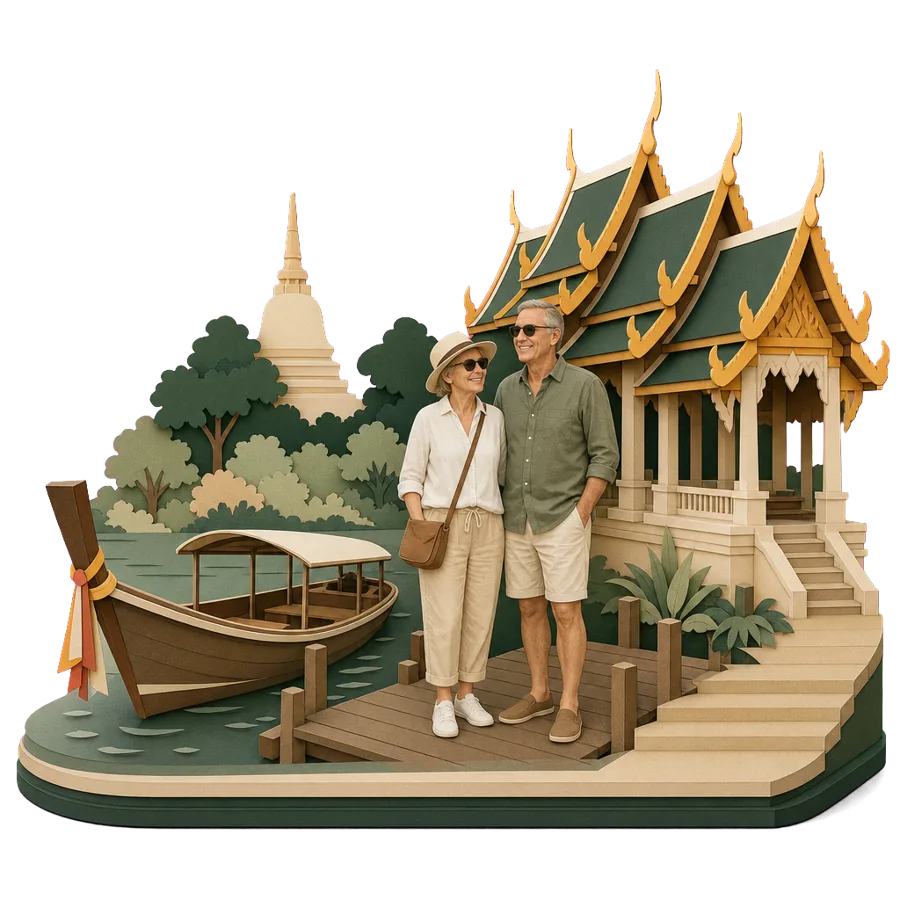
Cooler evenings, temples, mountains nearby and a slower pace.
Checked 21 October 2026, re-checked monthlyBy the Retirees Abroad teamGeneral information only, how we check
The short answer
A month in Chiang Mai costs about A$2,790 for a couple or A$1,950 for one person, rent included, on our October 2026 estimate. Since 15 September 2026, Australians get 30 days without a visa; retirement visas start at 50. Your Age Pension keeps paying, though Medicare never pays there. Smoke haze is worst in March.
Costs are mid-range estimates in Australian dollars, rent included, for a comfortable month. For comparison, a comfortable month in Australia is about A$6,580 for a couple who own their home (ASFA, June quarter 2026).

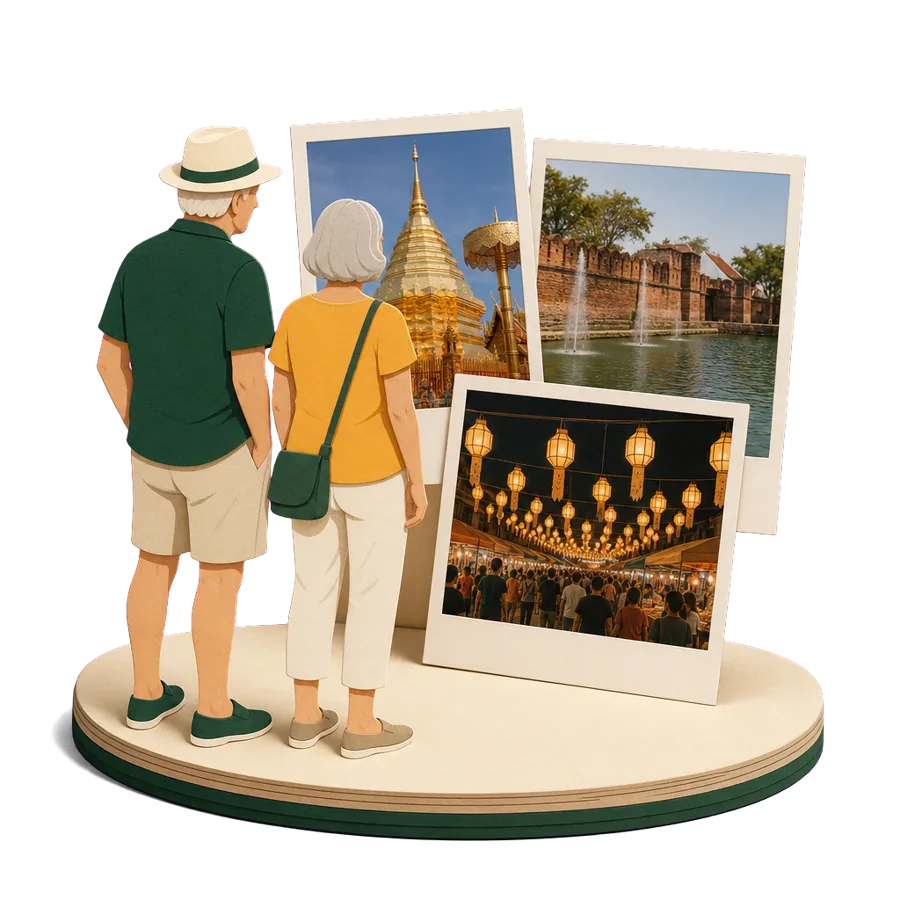
Chiang Mai suits you if you want a slower, cheaper life in the north of Thailand, with temples, markets and mountains close by. Our estimate for a couple, about A$2,790 a month with rent, is below the Age Pension’s overseas base rate. Health cover comes on top.
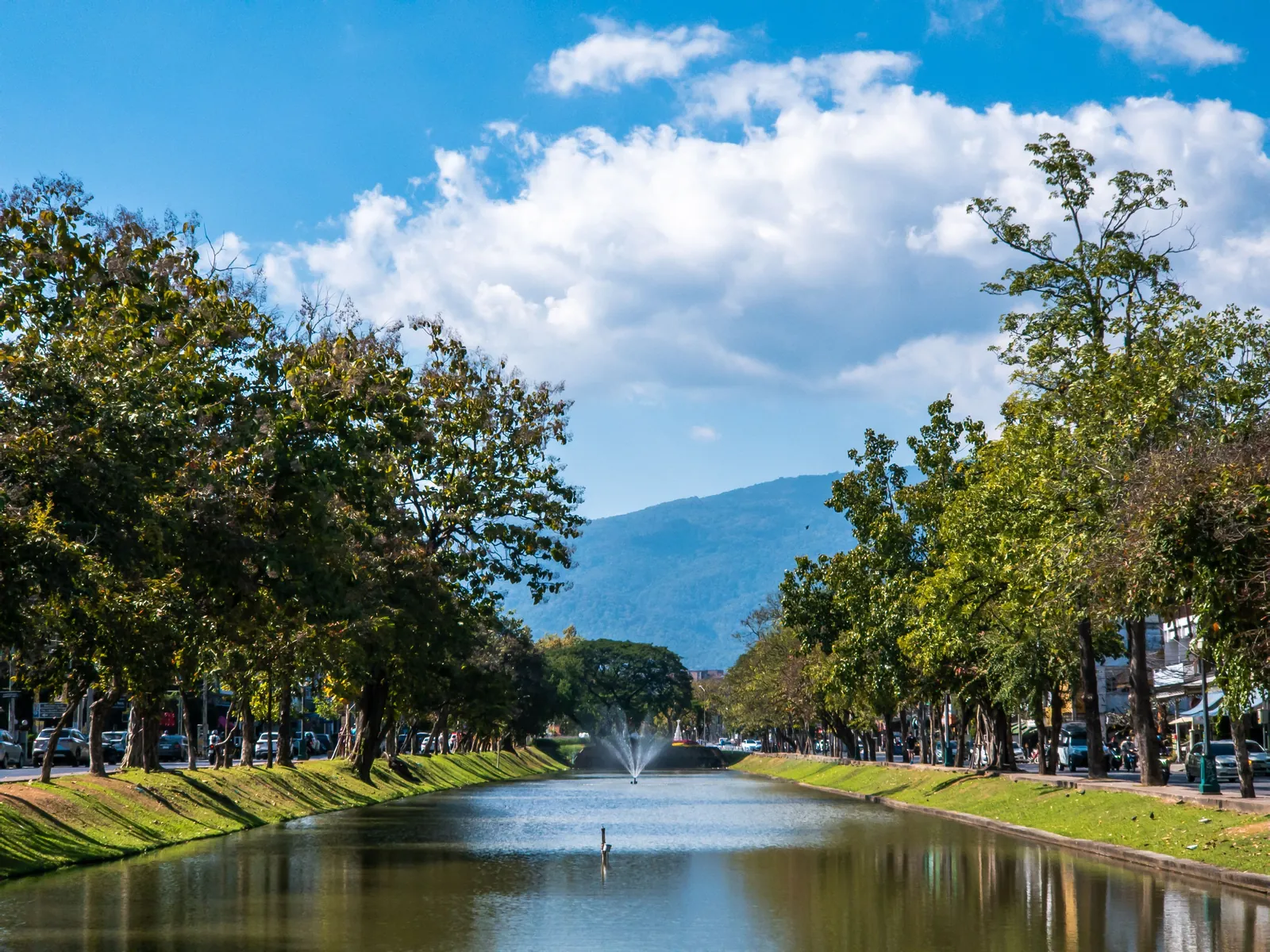
The air is the big drawback. Smartraveller says smoke haze is an issue across the north from December to April, and that air pollution in Chiang Mai can reach hazardous levels. Ten years of readings from a government monitor in the city put the worst of it in March. Those are dry months that visitors pick for the weather, so with asthma or a sinus or bronchial condition, talk to your doctor before choosing dates.
The visa-free stay dropped to 30 days in September 2026. Every Chiang Mai hospital on the Australian Embassy’s list is in the central district, so a house in the hills means a drive for care.
Our estimate for a month in Chiang Mai is about A$2,790 for a couple and A$1,950 for one person, rent included. We took Numbeo’s living costs for one person (without rent), added a one-bedroom city-centre rent, then added 30% for eating out, local trips and extras. For a couple we multiplied the living costs by 1.8. Everything is converted at the Reserve Bank of Australia’s average exchange rate for the 12 months to September 2026 (A$1 = 22.44 baht). Health insurance is not included. Numbeo’s Chiang Mai figures, updated 15 October 2026, are about 18,080 baht a month in living costs for one person (about A$810) and 15,580 baht for the flat (about A$690).
| A month in Chiang Mai | Couple | One person |
|---|---|---|
| Rent, one-bedroom flat in the centre | about A$690 | about A$690 |
| Living costs (food, transport, bills) | about A$1,450 | about A$810 |
| Eating out, local trips and extras (30%) | about A$650 | about A$450 |
| Total | about A$2,790 | about A$1,950 |
For a couple
About A$3,790 a month less than a comfortable month in Australia.
For one person
About A$2,730 a month less than a comfortable month in Australia.
Not built the same way: Australia's figure (ASFA Retirement Standard, comfortable, June quarter 2026) assumes you own your home and includes health insurance; our estimate for Chiang Mai includes rent and leaves health insurance out. Age Pension: the most paid in Australia from 20 September 2026; living overseas for good, the base rate is about A$3,710 a month for a couple and A$2,460 for one person.
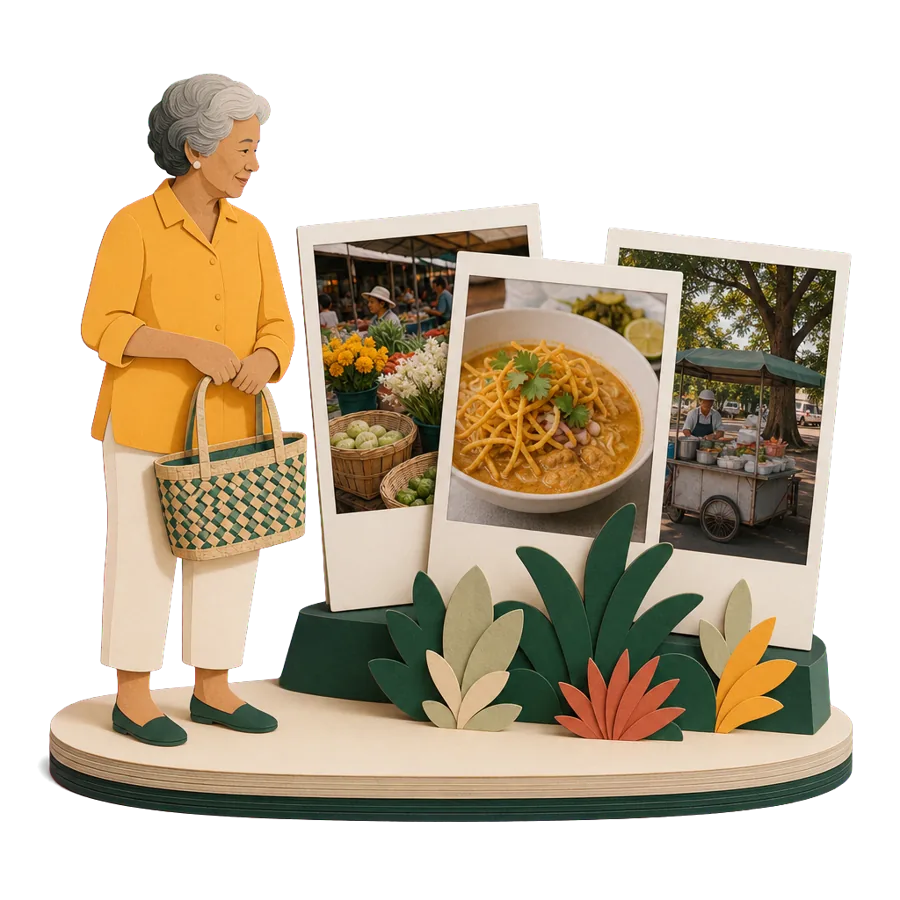
Against the Age Pension. After 12 weeks away, the most the Age Pension pays is the base rate. That is about A$2,460 a month for one person and A$3,710 for a couple, before tax (from 20 September 2026). It leaves about A$920 a month for a couple, or A$510 for one person, before health insurance. Our guide to what retiring overseas really costs compares six places.
Everyday prices. Numbeo’s Chiang Mai averages (15 October 2026) are a guide only.
| Item | Price |
|---|---|
| Meal at a cheap local restaurant | 75 baht (about A$3) |
| Three-course meal for two, mid-range | 650 baht (about A$29) |
| Bottle of mid-range wine | 600 baht (about A$27) |
| Power, water and rubbish for an 85 square metre flat, a month | 2,095 baht (about A$93) |
What costs more than you’d expect. Health cover is the big one; Smartraveller says your age and health affect its cost. Imported things are dear: one bottle of mid-range wine costs as much as eight cheap local meals. Each visa extension is 1,900 baht (about A$85) and a re-entry permit 1,000 baht (about A$45), Thai immigration lists.
Renting long term. A one-bedroom flat outside the centre costs about a third less than one in the centre, on Numbeo’s figures, and short furnished lets cost more. The Thailand page sets out how leases and deposits usually work. Under section 38 of the Immigration Act, whoever houses a foreigner must tell immigration within 24 hours, on the form known as TM.30.
Since 15 September 2026, Australians get 30 days in Thailand without a visa, down from 60, the Royal Thai Embassy in Washington says. Thai immigration can grant one extension of up to 30 days, for 1,900 baht (about A$85). Smartraveller says you may only be allowed 2 visa-free entries a calendar year without a justifiable reason.
For a full winter or longer, the retirement visas start at 50. The Non-O needs 800,000 baht (about A$35,650) in a Thai bank, or 65,000 baht (about A$2,900) a month in income, or a mix. The one-year Non-O-A, applied for before you go, adds health insurance of at least 3,000,000 baht (about A$134,000). None of the retirement visas allow work. Stay more than 90 days and you report your address every 90 days, online, by mail or in person.
Papers to get in Australia. The Non-O-A and the 10-year O-X ask for a police check and a medical certificate, each issued within 3 months. An Australian Federal Police national police check costs A$57, and the AFP says most online checks arrive within a few days. With fingerprints it costs A$114 and takes 15 to 30 business days. DFAT can legalise documents with an apostille when an embassy asks for it.
The Thailand page has the visa table, the partner rules and the e-Visa steps. Terms change, so check them with the Royal Thai Embassy, Thai immigration or a licensed visa agent in Thailand.
Services Australia says your Age Pension keeps paying while you live in Thailand, under the 6, 12 and 26-week rules. The Energy Supplement stops and your Pensioner Concession Card is cancelled after 6 weeks. After 12 weeks the Pension Supplement stops completely (since 20 September 2026). Thailand has no social security agreement with Australia, so you claim while you still live in Australia.
Medicare never pays for treatment in Chiang Mai, and none of Australia’s reciprocal health care agreements is with a country in Asia. An Australian citizen who moves overseas can still use Medicare in Australia for up to 5 years after leaving; visits home don’t restart that clock. Permanent residents lose their enrolment 12 months after they leave. The Thailand page covers the overseas pension rates in full.

Chiang Mai has private hospitals and a government teaching hospital, and you pay for all of it. Smartraveller says private hospitals in major cities have high standards and most of their doctors speak English. In public facilities, it says, most doctors speak limited English.
What is where. The Australian Embassy in Bangkok keeps a list of hospitals, last updated August 2025. Its Chiang Mai entries, by type:
| Type | How many | Where (subdistrict) | Languages listed |
|---|---|---|---|
| Private hospital | 4 | Wat Ket (two), Si Phum and Paton | English and Thai |
| Government university teaching hospital | 1 | Si Phum | Thai |
| Government psychiatric hospital | 1 | Hai Ya | English and Thai |
| Private rehabilitation centre for disabled and elderly people | 1 | Padaed | English and Thai |
All seven are in Mueang Chiang Mai, the central district, so Hang Dong and Mae Rim mean a drive.
Paying. Before they admit you, Smartraveller says, hospitals want a deposit and check your insurance and that your visa is valid. Without those you may pay cash up front, and costs can be very high. For an ambulance, call 1669.
When care means travelling. Smartraveller says hospitals in Bangkok and other large cities can treat serious illnesses and accidents; elsewhere you may need to be moved. Medical evacuation can be very expensive, and the Australian Government won’t pay for it. Ask the hospital and your insurer which treatments mean a flight to Bangkok.
Smoke, dengue and medicines. Smartraveller points to the World Air Quality Index for daily smoke readings. Dengue is a risk in the rainy season. Thailand’s Food and Drug Administration allows up to 30 days’ supply of psychotropic medicines with a prescription. More needs a permit, applied for at least 15 days ahead. Our guide to taking medicines overseas has the Australian side.
Insurance. For a visit, Smartraveller says travel insurance must cover all medical costs, evacuation included; see travel insurance for long stays. To live there, the usual type is international health insurance. The O-X needs a Thai policy with at least 400,000 baht (about A$17,830) of inpatient cover. Ask the oldest age you can join, whether cover continues as you get older, and whether the insurer pays a Chiang Mai hospital directly.
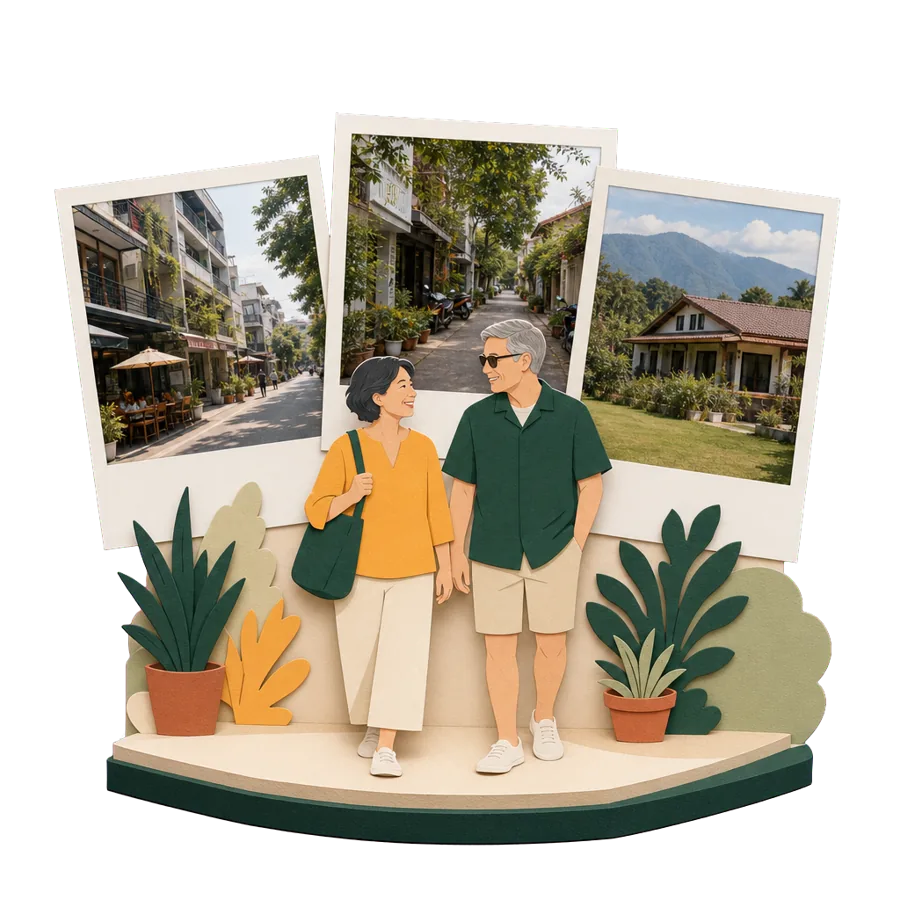
There are no official figures on where Australians live in Chiang Mai. Thailand Starter Kit, a guide for foreigners moving to Thailand, describes these five areas. Travel times are as it and Wikivoyage report; hospitals are from the Australian Embassy’s list.
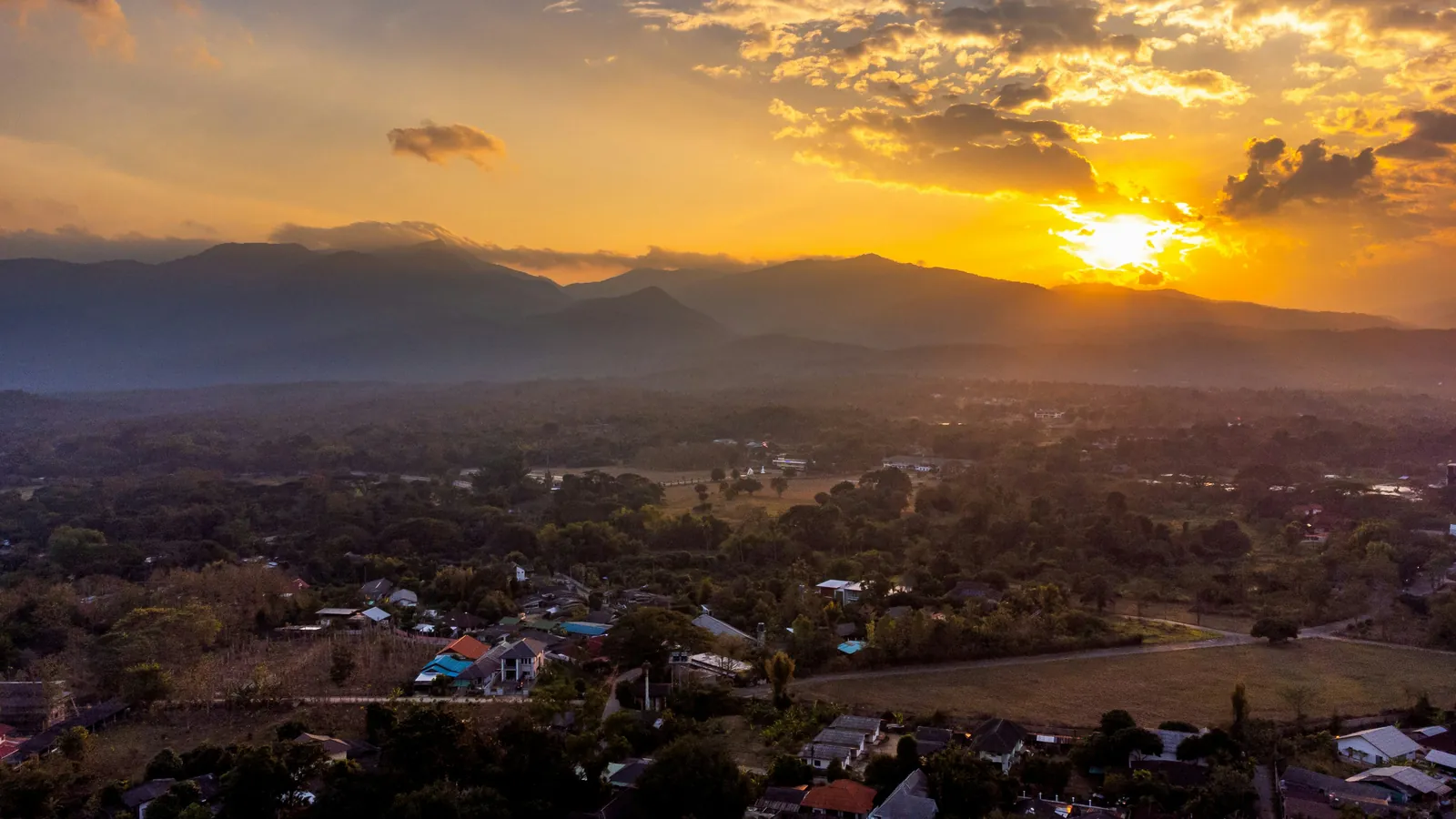
| Area | What it’s like | Getting around | Hospital | Airport |
|---|---|---|---|---|
| Old City | Temples, markets and guesthouses inside the moat; older buildings and plenty of visitors | Flat and walkable, about 1.6 km a side; red shared trucks | Government teaching hospital and a private hospital, both in Si Phum | About 3 km south-west of the centre, 10 to 15 minutes by car |
| Nimmanhaemin (Nimman) | Modern condos, cafes and shops west of the Old City; dearer rents | Flat; ride-hailing apps and red trucks | The central hospitals, close by | Close; Nimman sits under the flight path |
| Santitham | Local streets, lower rents and fewer tourists, just north of Nimman | Flat; red trucks and ride-hailing | The central hospitals, close by | In the city, a short drive |
| Hang Dong | Houses with gardens on the southern outskirts, around 30 minutes from the Old City | Own transport needed | None in the district | On the Hang Dong side of the city; no sourced drive time |
| Mae Rim | Rural, quiet and green, with mountain views, about 40 minutes from the city | Own transport needed | None in the district | About 40 minutes to the city, then 10 to 15 minutes more |
The Old City is the square inside the moat: flat, walkable lanes with temples, markets, visitors and older buildings.
Nimmanhaemin, Nimman for short, has modern condo buildings, and Thailand Starter Kit describes ones with a gym, pool and security. It reports one-bedroom rents there above Numbeo’s city-centre average of 15,580 baht (about A$690).
Santitham is quieter and more local, with lower rents than Nimman, the same guide says.
Hang Dong and Mae Rim suit people who want a house, a garden and quiet. You’ll be driving, and shopping and the hospitals are in the city.
The same guide names Chang Khlan Road and low-lying streets along the Ping River among the places that flood after heavy rain. A trial year lets you compare areas in the smoke months and the wet season.
You can rent straight away; buying is limited. Foreigners in general can’t own land in Thailand. They can own a condo unit if foreign owners hold no more than 49% of the building’s unit area and the money comes from overseas, the Thai government’s information site says. A house usually means leasing the land, for up to 30 years.
Using Thai nominee shareholders to hold land for a foreigner is illegal, and Smartraveller says scams in Thailand can involve property. The person to ask is a property lawyer in Thailand. The Thailand page sets out the routes and the risks. For the Australian side, see whether to keep, rent or sell the family home.
Thailand’s Revenue Department says you become a Thai tax resident once you spend more than 180 days there in a calendar year. A resident pays Thai tax on foreign income brought into Thailand. Foreign income earned from 1 January 2024, in a year you are resident, is taxed in the year you bring it into Thailand. Australia and Thailand have had a tax treaty since 1989, and its pensions article decides which country taxes a pension.
At home, the ATO’s tests decide whether you’re still an Australian resident for tax; see tax residency when you retire overseas. A foreign resident pays 30% on Australian income such as rent from the first dollar (2025-26). The Thailand page has the treaty and the 2024 change. Talk to a registered tax agent in Australia, and a tax adviser in Thailand, before you go.
The baht is the currency. Smartraveller says to change money only at authorised money changers, and that card skimming happens.
Away more than 12 months, Services Australia pays your pension every 4 weeks, into an Australian or an overseas account. A Thai account matters, because the retirement visas count money held in a Thai bank. Thai banks set their own rules for foreigners, so ask what they need from someone on your visa.
Your pension is in dollars and your rent in baht: 60,000 baht a month is about A$2,670 at the RBA’s average rate, and about A$2,970 if the dollar fell 10%. The Thailand page covers moving money.
Getting around. Thai is the official language, so a phrasebook or translation app helps with drivers. There’s no city train, Thailand Starter Kit reports. Wikivoyage reports that the red shared trucks charge 30 baht (about A$1) a trip inside the city walls. You flag one down, say where you’re going and pay when you get off. It also reports city buses at 20 baht (about A$1), paid in cash. Thailand Starter Kit reports ride-hailing trips around the city from 60 baht (about A$3). Smartraveller says to agree the fare first in a tuk-tuk, and check that a ride-hailing car’s plate matches the app.
Driving and motorbikes. Visitors need an International Driving Permit plus their Australian licence, Smartraveller says, and a motorbike needs a motorcycle licence and a helmet. Australians are regularly hurt or killed riding motorbikes in Thailand, and many hire companies have no insurance.
Safety and the law. Smartraveller advises a high degree of caution in Thailand overall; Chiang Mai is outside the areas it lists at higher levels. Drug penalties are severe, vapes are illegal, and you must carry ID.
Weather and smoke, month by month. December and January are the coolest months and April the hottest. The wet season runs from May to November, Smartraveller says. Smoke follows the dry season: it builds from January, peaks in March and has mostly cleared by June.
| Month | Average high | Average low | Rain | Days at or over the PM2.5 limit |
|---|---|---|---|---|
| January | 29°C | 14°C | 8 mm | 28% |
| February | 32°C | 16°C | 9 mm | 65% |
| March | 35°C | 19°C | 19 mm | 88% |
| April | 36°C | 22°C | 54 mm | 73% |
| May | 34°C | 24°C | 153 mm | 16% |
| June | 33°C | 24°C | 117 mm | under 1% |
| July | 32°C | 24°C | 153 mm | 0% |
| August | 31°C | 24°C | 225 mm | 0% |
| September | 32°C | 23°C | 200 mm | 0% |
| October | 31°C | 22°C | 118 mm | 0% |
| November | 30°C | 19°C | 51 mm | under 1% |
| December | 28°C | 15°C | 18 mm | 4% |
Weather: the Thai Meteorological Department, published by the World Meteorological Organization. Smoke: our calculation from a 2025 study in the Thai Environmental Engineering Journal. Its table 3 counts days from 2015 to 2024 when fine particles (PM2.5) at a government monitor in Chiang Mai were at or above 37.5 µg/m³, Thailand’s daily limit. We divided those by the days with readings. A NASA report written with Thai agencies links the March peak to crop burning and wildfires. In 2022, the first year of burning controls, the study found January to April pollution about 45% lower than in 2019.
Floods. Smartraveller says wet-season floods can cut power, roads, transport and phones. In October 2024, Chiang Mai’s governor said the latest flood, the second in six weeks, was bigger than expected, the Associated Press reported.
Public holidays. The Bank of Thailand has set 18 bank holidays for 2027, including Songkran, the Thai New Year, on 13 to 15 April.
Help at home. We haven’t found an official figure for what a cleaner or carer costs, so ask locally.

No airline flies non-stop from Australia to Chiang Mai. BITRE’s June 2026 figures show scheduled flights from Sydney, Melbourne, Brisbane and Perth to Bangkok. Non-stop flights from Sydney to Bangkok take about 9.5 hours, and from Perth about 7. From Bangkok you fly north, or Wikivoyage reports 12 to 15 hours by train and about 9 by the faster buses.
Chiang Mai is 3 hours behind Brisbane all year, 3 hours behind Sydney and Melbourne in our winter and 4 in daylight saving, and 1 hour behind Perth. For the return, our guide to coming home covers your pension and Medicare.
One order that works, from a first visit to living there:
It suits people who want low costs, a slower pace and cooler evenings than Bangkok or the beaches. Against that, there’s smoke haze from December to April, worst in March, and the visa-free stay is 30 days.
Our estimate is about A$2,790 a month for a couple and A$1,950 for one person, rent included, before health insurance. A retirement visa also needs 800,000 baht (about A$35,650) in a Thai bank, or 65,000 baht (about A$2,900) a month in income, or a mix.
We haven’t checked any retirement villages or care homes in Chiang Mai, so we can’t vouch for any. The Australian Embassy’s hospital list has one private rehabilitation centre there for disabled and elderly people. Our guide to aged care overseas or at home covers the Australian side.
The Non-O-A is applied for before you leave Australia, through the Thai e-Visa website. A Non-O is extended a year at a time at a Thai immigration office. Both need you to be 50 or over and meet the money test.
The Australian Embassy’s list shows four private hospitals in Chiang Mai, all listing English and Thai, and a government teaching hospital listing Thai. Smartraveller says most doctors at private city hospitals speak English.
Smartraveller says smoke haze affects the north from December to April. Ten years of readings show it worst in March, when pollution was at or above Thailand’s daily limit on 88% of days with readings (2015 to 2024).
Low costs, retirement visas from 50 and private hospitals count for it. Against it: the smoke, wet-season floods, the 30-day visa-free stay and no non-stop flights home.
Retirement visas start at 50 and day-to-day costs are low. The big cities have private hospitals.
A beach town on the Gulf of Thailand, about 200 kilometres south of Bangkok.
General information only, not financial, tax, legal, migration or insurance advice. Rules change: check the official source before you act, and talk to a licensed professional about your own situation.
Tell us what you have in mind, and we will help you plan it on a free Zoom call: when to go, how long for, and who with.
No pressure and no card details. You decide what comes next.