
Jay, 54: came to Jomtien on holiday and stayed
Checked 26 October 2026, re-checked monthlyBy the Retirees Abroad teamGeneral information only, how we check
The story in short
Jay, 54, from Burleigh Heads and St Kilda, went to Thailand for a holiday in 2023 and never went back to live. He lives near Jomtien Beach, south of Pattaya, on a retiree visa. He told Yahoo News Australia in September 2026 that about $2,000 a month covers his condo, food, bills, insurance and the gym.
Based on reporting by Yahoo News Australia: Retiree ditches Australia for 'better life' in Thailand for $2,000 a month (29 September 2026). This story is not affiliated with Retirees Abroad. We share it as one example of how an Australian went about it. Figures are theirs, as reported at the time.
The facts, as reported
- Who
- Jay
- From
- Burleigh Heads, Queensland, and St Kilda, Melbourne
- Where
- Jomtien, near Pattaya, Thailand
- How
- Full move
- The house
- Not stated; he rents a beachfront condo in Jomtien
- Income
- Not stated
- A month, as reported
- About $2,000 a month for everything, including $630 for his condo, as reported in September 2026 (the article does not say which dollars)
- How it turned out
- Settled in Jomtien on a retiree visa, and now helps other Australians make the move
How it came about

Jay had lived in Burleigh Heads on the Gold Coast and in St Kilda in Melbourne. In 2023 he went to Thailand for a holiday. He liked it enough to get a retiree visa and stay. He told Yahoo News Australia he didn’t set out to move at all. He was about 51 then.
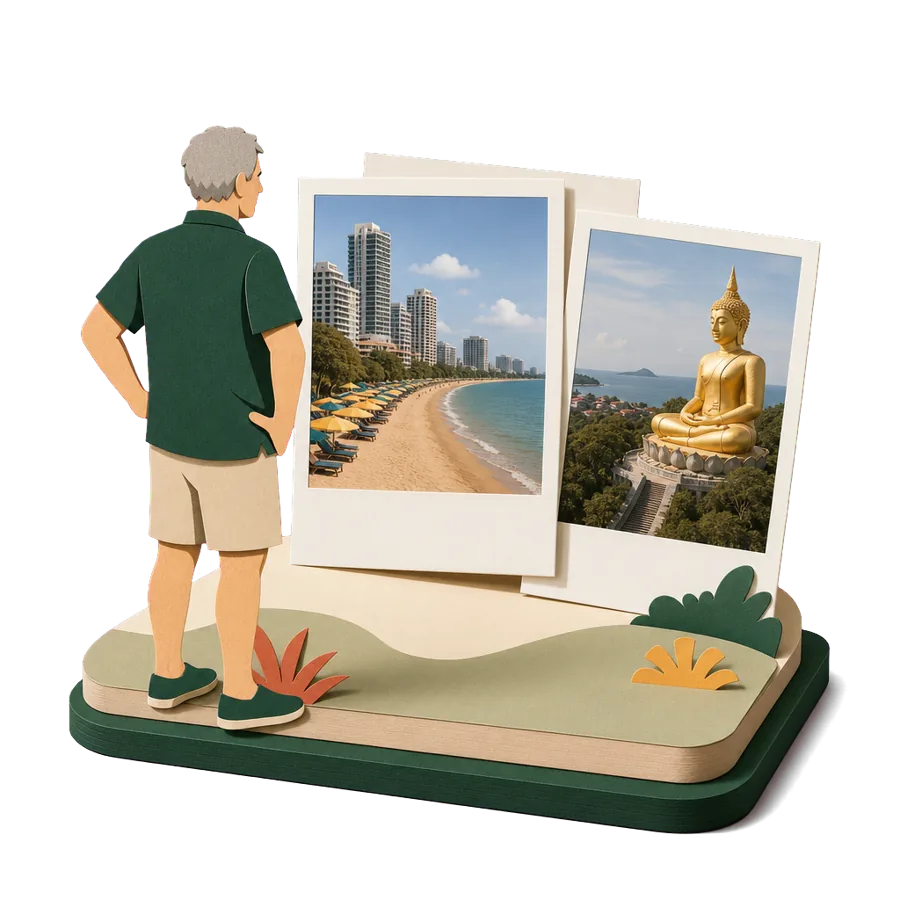
He now lives near Jomtien Beach, south of Pattaya, in a beachfront condo with pools.
What it costs them

Jay says he lives on about $2,000 a month, or roughly $65 a day. The article doesn’t say if that’s Australian or US dollars. By his count it covers:
- His beachfront condo: $630 of the $2,000.
- Food, bills and insurance.
- Entertainment, the gym and eating well.
A motorbike can be hired for as little as $1.50 a day, he says, and he walks most places, so he doesn’t need a car. He compares that with home, where he says five beers at a pub can cost $200. On a recent trip home he borrowed a car to visit family and spent $240 on fuel.
The article doesn’t say what his income is, what he did with any house in Australia, or what his insurance covers. Our guide to what retiring overseas really costs has our own estimates for Thailand, rent included.
What went well

He likes the warm weather and being able to walk everywhere. He also says he feels safer there than in Australia, and talks about families out on the beach late at night. In his words, “Your money goes a lot further here.”
What was hard
The article doesn’t say much about anything hard. Family is the part that pulls him back. He has family in Victoria and flew home recently to see them.
Jay now helps other older Australians make the same move, particularly retired men, and shares advice on social media.
What has changed since

- Visa-free stays are shorter. The Tourism Authority of Thailand says that from 15 September 2026, Australians get a 30-day visa exemption, down from 60 days. Entries over land borders on that exemption are generally limited to 2 a calendar year. A holiday that turns into a longer stay, as Jay’s did, now needs the right visa sooner.
- Retirement visas. Jay is on a retiree visa. Thailand’s retirement visas start at age 50 and ask for money in a Thai bank or a monthly income. For the Non-O-A, that is 800,000 baht (about A$35,650) in the bank or 65,000 baht a month (about A$2,900) in income, plus health insurance. The figures and conditions can change, so Thailand’s embassy or a licensed visa agent there can confirm them. Our Thailand retirement visa guide sets out the options.
- Before pension age. Jay is 54, well short of Age Pension age. Thailand has no social security agreement with Australia. Services Australia says that, unless you claim under an agreement, you must be living in Australia and physically in Australia on the day you claim the Age Pension.
What to take from it
- A holiday is a low-cost way to find out if you like a place. Jay’s became a move. A month or a winter away is a smaller step that leaves the house and family where they are. Our guide to trying a place before you move covers the steps in between.
- His $2,000 a month is his own count. It doesn’t say what currency, and it leaves out his income and what his insurance covers. Health cover is one cost that changes with age. Our guide to international health insurance by age covers what to ask.
- Retiring overseas years before pension age means planning how you would claim the pension later. Our guide to retiring overseas before 67 explains the gap years.
- If you get advice from someone who has made the move, it helps to check the visa and pension parts against official sources too.
The rules their story touches
- Thailand retirement visaFrom 15 September 2026 Australians get 30 days without a visa. For a season or longer: the Non-O, Non-O-A, O-X and LTR visas, age 50, money and insurance.
- Retiring before 67Age Pension age is 67, so the years before it run on your own money. When super can be reached, claiming the pension later, and health cover by age.
- Try before you moveSmartraveller suggests a 6 to 12 month temporary move before you commit. Build up from a winter away, and you may find two bases suit you better.
- What it really costsA month for a couple, rent included, from about A$2,470 in Da Nang to A$5,560 in Christchurch (our estimates), set against ASFA and the Age Pension.




The place
- ThailandRetirement visas start at 50 and day-to-day costs are low. The big cities have private hospitals.

Sources
- Yahoo News Australia: Retiree ditches Australia for 'better life' in Thailand for $2,000 a month, checked 26 October 2026 (dated 29 September 2026)
- Tourism Authority of Thailand: new 30-day and 15-day visa exemption rules from 15 September, checked 26 October 2026 (published 1 September 2026)
- Smartraveller: Thailand, checked 21 October 2026 (page updated 15 October 2026)
- Thai Ministry of Foreign Affairs: Non-Immigrant Visa O-A (Long Stay), checked 20 October 2026 (page updated 30 November 2022)
- Services Australia: Residence rules for Age Pension, checked 21 October 2026 (page updated 27 July 2026)
- Services Australia: International social security agreements, Asia, checked 21 October 2026 (page updated 25 August 2025)
General information only, not financial, tax, legal, migration or insurance advice. Rules change: check the official source before you act, and talk to a licensed professional about your own situation.
Weighing up something similar?
Tell us about your own plans, and we will help you work out where, how and who with, on a free Zoom call.
No pressure and no card details. You decide what comes next.